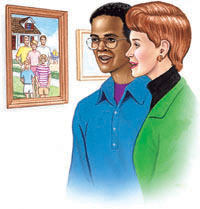
Add Emotion
Objective: To bring the dialog alive and to prevent students from reading the dialog in a flat voice; to help students understand the meaning of the dialog; to practice intonation
Steps:
- As students listen to the dialog on the audio program for the second time, raise the students' awareness of the emotions used by the speakers. Ask your students, "Does [name] sound happy, angry, excited?" and "How do you know?"
- Have students repeat certain emotional phrases.
- Have students practice the dialog in pairs or in small groups, adding emotion to the dialog.
Example: The following example is for New Interchange 2, Unit 1: "A Time to Remember." The dialog appears on p. 5 of the Student's Book.
Ask students to add emotion to sentences and phrases that appear in italics below. Helpful hints appear inside square brackets.
| Jeff: |
Hey! [excited] Are these pictures of you when you were a kid? [interested; voice going up at the end] |
| Kim: |
Yeah. That's me in front of my uncle's beach house. When I was a kid, we used to spend two weeks there every summer. |
| Jeff: |
Wow, I bet that was fun! [excited; stresses on the words bet and fun] |
| Kim: |
Yeah. We always had a great time. [happy; stress on the word great] Every day we used to get up early and walk along the beach. I had a great shell collection. In fact, I think it's still up in the attic! [laughing; stresses on the words still and attic] |
| Jeff: |
Hey, I used to collect shells, too, when I was a kid. But my parents threw them out! [laughing; stresses on the words parents and out] |
|
Adaptation: All of the Conversations in the New Interchange series contain examples of speakers in real situations, showing surprise, annoyance, excitement, happiness, interest, and so on. This activity can be – and should be – exploited for any Conversation exercise.
Variation: Have students add actions, too. For example, have the student playing Jeff point to the picture of Kim when she was a kid.
|
|