|
|
|

|
What's This?
The activities below provide fun exercises for the entire class when you have extra time. They are designed to be taught with specific exercises in this unit. Click on an activity in the list below or scroll down the page.
|
|

Go to the Resources Page for This Unit |
Game – Hangman
This activity is designed to be taught with Exercise 6, "What's This Called?"
Time: 20 minutes. This popular game can be used to practice vocabulary and spelling in any unit.
- Each student chooses a word from the unit.
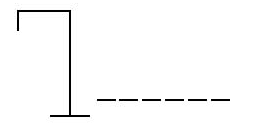
- Students take turns going to the board. The student at the board draws the hangman diagram and blanks – one blank for each letter of the word he or she has chosen:
- The student at the board calls on other students to take turns guessing the letters of the word. If someone guesses a correct letter, it is written in the appropriate blank. If the guess is wrong, the student at the board draws one part of the body on the gallows. There are nine body parts, which are drawn in this order: head, neck, left arm, right arm, body, left leg, right leg, left foot, and right foot.
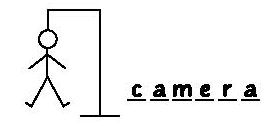
- The object of the game is for someone to guess the correct word before the picture of the hangman's body is completed. The student who guesses the word is the winner and gets to be the next student at the board. If the body is complete, the student at the board wins.
|
Back to Top
|
Crossword puzzle
This activity is designed to be taught with Exercise 6, "What's This Called?"
Time: 15 minutes. This activity is good for reviewing vocabulary in any unit and for practicing spelling.
- Students form pairs or groups and then make crossword puzzle grids of 12 squares by 12.
- Students can refer to the Unit Summary at the back of the Student's Book. Using words from the list, students try to fit in as many words as possible onto their grids. Words can go across or down. Every word must include at least one letter that is in another word. Letters that are next to each other must be part of a complete word.
- This example uses names of objects from Unit 2.
|
|
|
w |
|
|
|
|
|
|
|
c |
|
|
|
|
|
|
|
|
w |
a |
s |
t |
e |
b |
a |
s |
k |
e |
t |
|
|
|
|
|
|
|
|
t |
|
|
|
o |
|
|
|
l |
|
|
|
|
|
|
| c |
l |
o |
c |
k |
|
|
o |
|
|
|
l |
|
|
|
|
|
|
|
|
|
h |
|
|
|
k |
|
|
|
p |
u |
r |
s |
e |
|
|
|
|
|
|
|
|
|
|
|
|
|
h |
|
|
|
r |
|
|
|
|
|
|
|
|
|
|
|
|
|
o |
|
|
m |
a |
p |
|
|
|
|
|
|
|
|
|
|
|
|
n |
|
|
|
s |
|
|
|
|
|
|
|
|
|
|
|
|
|
e |
|
|
k |
e |
y |
s |
|
|
|
|
|
|
|
|
|
|
|
|
|
|
|
r |
|
|
- After ten minutes, stop the activity and find out who has the most words on the grid.
|
Back to Top
|
Scrambled letters
This activity is designed to be taught with Exercise 6, "What's This Called?"
Time: 5–10 minutes. This type of activity can be used with any unit for a fun review. This puzzle reviews vocabulary and spelling from Unit 1. All of the words in the puzzle come from Exercises 6 (Saying Hello) and 11 (Saying Good-bye).
- Copy this on the board:
| n i e f |
f __ __ __ |
| r e a l t |
l __ __ __ __ |
| l o h e l |
h __ __ __ __ |
| g t i h n |
n __ __ __ __ |
| s k a n t h |
t __ __ __ __ __ |
| n e e v i n g |
e __ __ __ __ __ __ |
| o r g m i n n |
m __ __ __ __ __ __ |
| r o t o r m o w |
t __ __ __ __ __ __ __ |
| g d o o – y b e |
g __ __ __ __ __ __ __ |
| f o r o n a n e t |
a __ __ __ __ __ __ __ __ |
- Have students work in pairs to unscramble the words.
- Check answers on the board with the whole class. Make sure students have spelled the words correctly.
Answers
| fine |
thanks |
good-bye |
| later |
evening |
afternoon |
| hello |
morning |
|
| night |
tomorrow |
|
|
Back to Top
|
True or false?
This activity is designed to be taught with Exercise 9, "Word Power: Prepositions; article the."
Time: 10–15 minutes. This activity can be used in any unit to practice writing descriptive statements. In this unit, the activity practices prepositions of place.
- Explain the activity: Students write six statements about the positions of objects in the classroom. Four should be true and two should be false.
- Students form groups and take turns reading their statements while others look around the classroom to verify the statements. If a statement is true, students should say, "True." If a statement is false, they say, "False," and then correct the statement.
|
Back to Top
|
Spelling contest
This activity is designed to be taught with Exercise 11, "Where Are My Things?"
Time: 10–15 minutes. This game is good for reviewing vocabulary in any unit and for practicing spelling. Here, it also helps students learn each other's names.
Preparation: Give students a list of all the students' names to review beforehand, if necessary. Use first names alone. Cut up the list so that each name is on a separate slip of paper. Put the slips into an envelope.
- In class, divide the students into two teams and announce a time limit (10–15 minutes).
- Draw a name from the envelope, and say the name to a student on the first team. If the student spells the name correctly, select a second name, and say it to the next person on the same team. When a student misspells a name, that student sits down and it becomes the turn of the other team.
- The winner is the team that spells the most names correctly (has the most people standing) within the time limit.
|
Back to Top
|
|
|
