|
|
|

|
Where Are You From?
The activities below provide fun exercises for the entire class when you have extra time. They are designed to be taught with specific exercises in this unit. Click on an activity in the list below or scroll down the page.
|
|

Go to the Resources Page for This Unit |
Yes or no?
This activity is designed to be taught with Exercise 3, "Grammar Focus: Statements and yes/no questions with be."
Time: 5 minutes. This activity provides controlled practice of yes/no questions and short answers.
- Ask students about their city, country, or first language using yes/no questions. If they answer no, have them give the correct information. For example:
Teacher: Are you from Tokyo, Kenji?
Kenji: Yes, I am.
Teacher: Sonia, is Kenji from Osaka?
Sonia: No, he isn't. He's from Tokyo.
- After a few questions and answers, let volunteers ask the questions.
|
Back to Top
|
Game – Hangman
This activity is designed to be taught with Exercise 4, "Regions of the World."
Time: 20 minutes. This popular game can be used to practice vocabulary and spelling in any unit.
- Each student chooses a word from the unit.
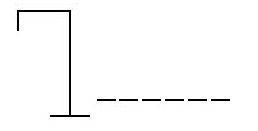
- Students take turns going to the board. The student at the board draws the hangman diagram and blanks – one blank for each letter of the word he or she has chosen:
- The student at the board calls on other students to take turns guessing the letters of the word. If someone guesses a correct letter, it is written in the appropriate blank. If the guess is wrong, the student at the board draws one part of the body on the gallows. There are nine body parts, which are drawn in this order: head, neck, left arm, right arm, body, left leg, right leg, left foot, and right foot.
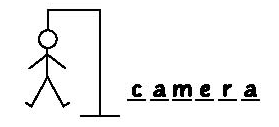
- The object of the game is for someone to guess the correct word before the picture of the hangman's body is completed. The student who guesses the word is the winner and gets to be the next student at the board. If the body is complete, the student at the board wins.
|
Back to Top
|
Scrambled letters
This activity is designed to be taught with Exercise 4, "Regions of the World."
Time: 5–10 minutes. This type of activity can be used with any unit for a fun review. This puzzle reviews vocabulary and spelling from Unit 1. All of the words in the puzzle come from Exercises 6 (Saying Hello) and 11 (Saying Good-bye).
- Copy this on the board:
| n i e f |
f __ __ __ |
| r e a l t |
l __ __ __ __ |
| l o h e l |
h __ __ __ __ |
| g t i h n |
n __ __ __ __ |
| s k a n t h |
t __ __ __ __ __ |
| n e e v i n g |
e __ __ __ __ __ __ |
| o r g m i n n |
m __ __ __ __ __ __ |
| r o t o r m o w |
t __ __ __ __ __ __ __ |
| g d o o – y b e |
g __ __ __ __ __ __ __ |
| f o r o n a n e t |
a __ __ __ __ __ __ __ __ |
- Have students work in pairs to unscramble the words.
- Check answers on the board with the whole class. Make sure students have spelled the words correctly.
Answers
| fine |
thanks |
good-bye |
| later |
evening |
afternoon |
| hello |
morning |
|
| night |
tomorrow |
|
|
Back to Top
|
That's wrong!
This activity is designed to be taught with Exercise 4, "Regions of the World."
Time: 20 minutes. This activity practices the names of countries and regions.
- Explain the task: Each student writes five to ten statements about the location of countries (in regions). Some of the statements should be false and some true, for example: "Mexico is in South America," "The United States is in North America."
- In groups of four, each student reads his or her statements aloud. The other students try to identify the false statements and to correct the false information in them.
- In case of disagreements, you can supply the answer yourself, or have students find out the answer for the next class.
|
Back to Top
|
Game – Higher, lower
This activity is designed to be taught with Exercise 6, "Numbers and Ages."
Time: 10–15 minutes. This game reviews numbers from 1 to 100.
- Students work in two groups. Each group writes down five numbers between 11 and 100, but does not let the other group see.
- Explain the game and the idea of higher and lower. Demonstrate the task with a student:
Teacher: I'm thinking of a number between 30 and 40.
Student: Is it 35?
Teacher: No. Higher. (point up)
Student: Is it 39?
Teacher: No. Lower. (point down)
Student: Is it 37?
Teacher: Yes, it is.
- The student who is up first tells the range of ten that the number is between. The student then calls on students in the other group to take turns guessing the number. Keep track on the board of how many guesses each group makes. The student who guesses the number gets to be the next student up.
- The winner is the group that has the fewest number of guesses at the end of the game.
|
Back to Top
|
Game – What's the question?
This activity is designed to be taught with Exercise 10, "Grammar Focus: Wh-questions with be."
Time: 10–15 minutes. This activity can be used to practice the formation of questions in any unit. In this unit, it reinforces the meaning of Wh-words related to personal information.
Preparation: Each student needs three index cards, or a sheet of paper torn into thirds.
- Divide the class into two teams. Make sure each student has three cards or slips of paper.
- Write these examples on the board:
That's Jill.
He's tall and thin.
She's from Mexico.
- Elicit the question for each statement (Who's that? What's he like? Where's she from?).
- Explain that each student needs to think of three similar statements that can answer Wh-questions. Students write one statement on each card. Walk around the class and give help as needed. Allow students to consult and help their teammates. It's all right if some answers elicit the same question.
- Collect all the cards and put them in a pile facedown.
- Team A starts: One student picks up a card and reads it aloud to a student from Team B. That student then tries to make a suitable Wh-question for it.
- Students on both teams decide whether the question is correct or not. If it is, Team B wins a point. If it isn't, a student from Team A tries to correct it. If the correction is acceptable, Team A gets the point instead.
- Keep a tally of the scores on the board. The team with the most points wins.
- To make the contest more exciting, set a time limit. Students must begin to respond before the time is up.
|
Back to Top
|
|
|
