|
|
|

|
You Can Play Baseball Really Well.
The activities below provide fun exercises for the entire class when you have extra time. They are designed to be taught with specific exercises in this unit. Click on an activity in the list below or scroll down the page.
|
|

Go to the Resources Page for This Unit |
Olympic sports
This activity is designed to be taught with Exercise 1, "Snapshot: Sports Seasons in the United States and Canada."
Time: 10–15 minutes. This whole-class activity provides additional practice with vocabulary for sports.
- Write the following chart on the board:
- Have students come up with as many sports as possible for each category. If necessary, help students with the English names of Olympic sports.
Possible answers
Winter sports
Bobsled
Figure skating
Hockey
Luge
Skiing
Ski jumping
Skating
|
Summer sports
Diving
Swimming
Baseball
Cycling
Gymnastics
Sailing
Soccer
Tennis
Volleyball
|
|
- Ask students , "What is your favorite winter sport? What is your favorite summer sport?" Take a survey using the sports on the board.
|
Back to Top
|
Scrambled letters
This activity is designed to be taught with Exercise 10, "Reading: Race the U.S.!"
Time: 5–10 minutes. This type of activity can be used with any unit for a fun review. This puzzle reviews vocabulary and spelling from Unit 1. All of the words in the puzzle come from Exercises 6 (Saying Hello) and 11 (Saying Good-bye).
- Copy this on the board:
| n i e f |
f __ __ __ |
| r e a l t |
l __ __ __ __ |
| l o h e l |
h __ __ __ __ |
| g t i h n |
n __ __ __ __ |
| s k a n t h |
t __ __ __ __ __ |
| n e e v i n g |
e __ __ __ __ __ __ |
| o r g m i n n |
m __ __ __ __ __ __ |
| r o t o r m o w |
t __ __ __ __ __ __ __ |
| g d o o – y b e |
g __ __ __ __ __ __ __ |
| f o r o n a n e t |
a __ __ __ __ __ __ __ __ |
- Have students work in pairs to unscramble the words.
- Check answers on the board with the whole class. Make sure students have spelled the words correctly.
Answers
| fine |
thanks |
good-bye |
| later |
evening |
afternoon |
| hello |
morning |
|
| night |
tomorrow |
|
|
Back to Top
|
Game – Hangman
This activity is designed to be taught with Exercise 10, "Reading: Race the U.S.!"
Time: 20 minutes. This popular game can be used to practice vocabulary and spelling in any unit.
- Each student chooses a word from the unit.
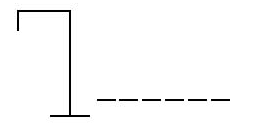
- Students take turns going to the board. The student at the board draws the hangman diagram and blanks – one blank for each letter of the word he or she has chosen:
- The student at the board calls on other students to take turns guessing the letters of the word. If someone guesses a correct letter, it is written in the appropriate blank. If the guess is wrong, the student at the board draws one part of the body on the gallows. There are nine body parts, which are drawn in this order: head, neck, left arm, right arm, body, left leg, right leg, left foot, and right foot.
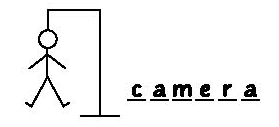
- The object of the game is for someone to guess the correct word before the picture of the hangman's body is completed. The student who guesses the word is the winner and gets to be the next student at the board. If the body is complete, the student at the board wins.
|
Back to Top
|
Game – Word bingo
This activity is designed to be taught with Exercise 10, "Reading: Race the U.S.!"
Time: 10–15 minutes. This activity reviews words from Units 1–4.
- Show students how to make a Bingo card on an 8½ X 11-inch sheet of paper with 25 spaces on it, like this:
| B |
I |
N |
G |
O |
| morning |
she |
fall |
pen |
I |
| winter |
afternoon |
it |
desk |
sister |
| clock |
mother |
FREE |
evening |
you |
| he |
chair |
summer |
family |
night |
| parents |
book |
pencil |
spring |
brother |
- Make up a list of twenty-four words. This list could include names of objects, clothing, colors, countries and regions, descriptive adjectives, seasons and weather, or prepositions of place.
- Write the words on the board, and have students write them down in random order on their bingo cards, without repetitions. Students write free in the center space.
- Dictate words at random. (You may repeat the word several times, depending on your students' abilities.) students find words on their cards and circle them. Keep a list of the words you call so that no words are repeated. (You will need the list to check cards when students call "Bingo.")
- The first student to circle five words in a row (or four words plus the free space) in any direction shouts, "Bingo!"
- Ask the student to read the circled words aloud. Check your list. If all the words are correct, the student wins.
|
Back to Top
|
Complete the word
This activity is designed to be taught with Exercise 10, "Reading: Race the U.S.!"
Time: 10–15 minutes. This activity can be used to practice vocabulary and spelling in any unit. Here students review verbs from Unit 5, Exercises 7 and 9.
- Copy the following on the board:
| 1. |
_ a _ |
| 2. |
_ w _ _ |
| 3. |
_ _ d _ |
| 4. |
_ r _ _ _ |
| 5. |
_ _ _ _ p |
| 6. |
_ _ _ c _ |
| 7. |
_ _ n _ _ |
| 8. |
_ _ l _ |
| 9. |
_ h _ _ |
| 10. |
_ o _ _ |
- Tell students the answers are in Unit 5, Exercises 7 and 9. Have students work in pairs to find the words and fill in the missing letters.
- Check answers on the board with the class.
Answers
- eat
- swim
- ride
- drive
- sleep
- watch
- dance
- walk
- shop
- work
|
Back to Top
|
In my free time
This activity is designed to be taught with Exercise 10, "Reading: Race the U.S.!"
Time: 20–25 minutes. This activity provides additional practice with simple present questions and can and can't.
- Set a time limit of 10 minutes. Write the cues on the board:
What I like to do in my free time
I like . . . (sports/activities/music/etc.)
I usually/often/sometimes . . . in the evening.
I . . . on Saturdays/Sundays.
I can . . . .
I can't . . . .
- Ask students to use the cues to write five true statements about themselves – each on a separate piece of paper or index card. They should try to think of things that are unusual or even unique. As they write, go around the class to help and to check their work.
- Collect the papers, mix them up, and give one to each student. A student who gets his or her own paper should immediately trade it for another one.
- Explain the activity: Students ask one another questions based on the information they have in the statements on the papers. When they find the person who fits a statement, they write the student's name on it. Then they get another statement.
- Set a time limit of about ten minutes. Students walk around asking questions and matching students with statements. Whoever finds the most people is the winner.
|
Back to Top
|
|
|
