|
|
|

|
Please Call Me Chuck.
The activities below provide fun exercises for the entire class when you have extra time. They are designed to be taught with specific exercises in this unit. Click on an activity in the list below or scroll down the page.
|
|

Go to the Resources Page for This Unit |
The name game
This activity is designed to be taught with Exercise 2, "Checking Information."
Time: 10 minutes. Students may enjoy this as an icebreaker on their first or second day of class. Decide if students should use only first names or both first and last names while playing the game.
- The class sits or stands in a circle.
- Use something small, like a tennis ball or a paper ball. Say your name and throw the ball to a student.
- This student quickly says his or her name and throws the ball to another student.
- Continue until all students have participated.
- Optional: Play the game again, this time with students saying the name of the person they are throwing the ball to.
|
Back to Top
|
Scrambled letters
This activity is designed to be taught with Exercise 4, "Conversation: Introducing someone."
Time: 5–10 minutes. This activity can be used with any unit for a fun vocabulary review and spelling exercise.
Preparation: Near the end of a cycle, choose ten words and scramble the letters of each one. Use the Unit Summaries in the back of the Student's Book to help you. If possible, choose ten words that are related to one another in some way (e.g., words for jobs in Unit 2; words for clothing in Unit 3; all nouns).
- In class, write the scrambled words on the board. To make the task easier, give students the first letter:
| 1. |
d e n f i r |
(f ___________________________) |
| 2. |
t s a e p r n |
(p ___________________________) |
| 3. |
e t t u s n d |
(s ___________________________) |
| 4. |
e n m |
(m ___________________________) |
| 5. |
r e t e h |
(t ___________________________) |
| 6. |
l e a m |
(m ___________________________) |
| 7. |
g e n i l s |
(s ___________________________) |
| 8. |
s l a c s |
(c ___________________________) |
| 9. |
e w n o m |
(w ___________________________) |
| 10. |
k e n m i c a n |
(n ___________________________) |
- Pairs rearrange the letters to find the words. Check students' answers.
Answers
- friend
- parents
- student
- men
- there
- male
- single
- class
- women
- nickname
|
Back to Top
|
Lots of languages
This activity is designed to be taught with Exercise 5, "Grammar Focus: Wh-questions and statements with be."
Time: 5 minutes. This activity introduces the names of languages that students speak.
In a heterogeneous class:
- Find out how many different first languages there are in the class. Ask questions like these and write the information on the board for students to copy into their notebooks:
Teacher: What's your first language, Celia?
Student: Spanish.
Teacher: How many of you speak Spanish as a first language?
In either a homogeneous or heterogeneous class:
- Find out how many different foreign languages students are studying or know how to speak. Ask questions like these and write the information on the board:
Teacher: Who is studying another foreign language?
Student 1: I'm studying Chinese.
Student 2: I'm studying French.
Teacher: And who speaks another foreign language?
Student 3: I speak German.
|
Back to Top
|
Who am I?
This activity is designed to be taught with Exercise 8, "Grammar Focus: Yes/No questions and short answers with be."
Time: 10–15 minutes. This activity practices yes/no questions.
Preparation: Cut out magazine pictures (one for each student ) of well-known people that students are sure to know (e.g., famous entertainers, TV personalities, politicians, people currently in the news).
- Introduce or review the names for different kinds of entertainers (e.g., actor, actress, singer, musician) and for other famous people (e.g., politician, government leader, president, prime minister, king, TV personality, talk show host).
- Ask each student to come to the front of the class. Pin or tape a picture to the student's back without him or her seeing it. If possible, use pictures of women for female students and pictures of men for male students.
- Explain the task: Each student tries to guess whose picture is on his or her back. Students can use only yes/no questions to find out who it is.
- Model the task by asking a student to pin a picture on your back (e.g., the picture here is of Boris Yeltsin):
Teacher: Am I an entertainer?
Student: No, you aren't.
Teacher: Am I a politician?
Student: Yes, you are.
Teacher: Do I live in North America?
Student: No, you don't.
Teacher: Do I speak Russian?
Student: Yes, you do.
Teacher: Am I President Yeltsin?
Student: Yes, you are!
- Now students move around the class trying to identify their pictures. When a student correctly guesses the person's name, he or she sits down.
- Stop the activity after about ten minutes. Find out how many students guessed their person's name correctly.
|
Back to Top
|
Crossword puzzle
This activity is designed to be taught with Exercise 10, "Reading: Meeting and greeting customs." See also the new crossword puzzle created for Review of Units 1–4.
Time: 15 minutes. This activity is good for reviewing vocabulary in any unit and for practicing spelling.
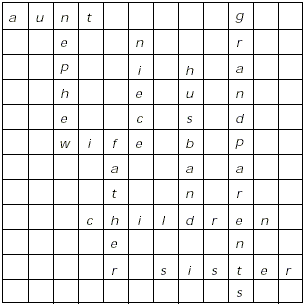
- Students form pairs or groups and then make a crossword puzzle grid of 12 by 12 lines.
- Students use words from the unit and try to fit in as many as possible on their grids. (Note: The example grid below uses words connected to family and relatives from Unit 5.)
- After ten minutes, stop the activity and find out who has the most words on the grid. Ask that student to read each word aloud and to spell each one; the rest of the class listens and circles the same words on their grids.
|
Back to Top
|
|
|