|
|
|

|
How Do You Spend Your Day?
The activities below provide fun exercises for the entire class when you have extra time. They are designed to be taught with specific exercises in this unit. Click on an activity in the list below or scroll down the page.
|
|

Go to the Resources Page for This Unit |
What's his/her job?
This activity is designed to be taught with Exercise 2, "Word Power: Jobs."
Time: 10 minutes. In this activity, students guess people's jobs while using Wh- and yes/no questions and short responses.
Preparation: Ask students to look through magazines and newspapers for pictures of people who seem to have interesting or unusual jobs. Tell each student to bring about four pictures to class.
- Collect the pictures, mix them up, and divide them into sets – one set for each group.
- Form students into groups and give each a number (e.g., Group 1, Group 2). Explain the activity: Students try to identify each person's job. When the group agrees on a job title for a person, the secretary writes the group number on the back of the picture, along with the name of the job. Let students use their dictionaries.
- Write these dialogues on the board and model them:
A: Is he/she a/an . . . ?
B: Yes, he/she is. (or) No, he/she isn't.
A: What's his/her job?
B: I think he's/she's a/an . . . .
C: Yes, I agree. (or) No, I think he's/she's a/an . . . .
- Give one set of pictures to each group. Set a limit of five minutes. While groups work, walk around and give help as needed.
- When time is up, tell groups to choose the three most interesting pictures and to pass them on to another group. Without looking at the back of the picture, the new group tries to identify each job. Do they agree with the previous group's suggestions?
|
Back to Top
|
Scrambled letters
This activity is designed to be taught with Exercise 3, "Work and Workplaces."
Time: 5–10 minutes. This activity can be used with any unit for a fun vocabulary review and spelling exercise.
Preparation: Near the end of a cycle, choose ten words and scramble the letters of each one. Use the Unit Summaries in the back of the Student's Book to help you. If possible, choose ten words that are related to one another in some way (e.g., words for jobs in Unit 2; words for clothing in Unit 3; all nouns).
- In class, write the scrambled words on the board. To make the task easier, give students the first letter:
| 1. |
d e n f i r |
(f ___________________________) |
| 2. |
t s a e p r n |
(p ___________________________) |
| 3. |
e t t u s n d |
(s ___________________________) |
| 4. |
e n m |
(m ___________________________) |
| 5. |
r e t e h |
(t ___________________________) |
| 6. |
l e a m |
(m ___________________________) |
| 7. |
g e n i l s |
(s ___________________________) |
| 8. |
s l a c s |
(c ___________________________) |
| 9. |
e w n o m |
(w ___________________________) |
| 10. |
k e n m i c a n |
(n ___________________________) |
- Pairs rearrange the letters to find the words. Check students' answers.
Answers
- friend
- parents
- student
- men
- there
- male
- single
- class
- women
- nickname
|
Back to Top
|
Game – What's the question?
This activity is designed to be taught with Exercise 5, "Grammar Focus: Simple present Wh-questions and statements."
Time: 10–15 minutes. This activity reviews Wh-questions.
Preparation: Each student will need three blank cards.
- Divide the class into two teams – Teams A and B. (Note: This activity can also be done in groups.) Give each student three blank cards.
- Students think of three statements that could be answers to Wh-questions (e.g., She works in a zoo. He's a flight attendant for United. I study dance at UCLA.). Then students write one statement on each card. Walk around the class and give help when needed.
- Collect all of the students' cards and put them in a pile facedown.
- Team A starts: One student picks up a card and reads it aloud to a student from Team B. That student then tries to make a suitable Wh-question for it. Students on both teams decide whether the question is correct or not. If it is, Team B wins a point; if it isn't, a student from Team A tries to correct it. If the correction is acceptable, Team A gets the point instead. Keep a tally of the scores on the board. The team with the most points wins.
|
Back to Top
|
True or false?
This activity is designed to be taught with Exercise 10, "Listening."
Time: 10–15 minutes. This activity practices making descriptions.
- Explain the activity: Students write six statements about themselves – four should be true and two false.
- Students form groups and take turns reading their statements aloud while others try to guess which are true and which are false.
|
Back to Top
|
Game – Word Bingo
This activity is designed to be taught with Exercise 11, "Reading: The daily grind."
Time: 10–15 minutes. This activity reviews vocabulary and spelling, and practices listening for and writing down key words. It can easily be used with any unit.
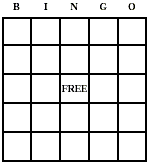
- Make up a list of 24 words from Unit 5. Then show students how to make a Bingo card on an 8½" X 11" sheet of paper with 25 spaces on it, like this:
- Dictate the words from your list: First, say the word and spell it. Then use it in a sentence, like this:
Teacher: Family. F-A-M-I-L-Y. There are three in my family.
- Students listen and write down each word inside a box in random order on their Bingo cards.
- One by one, randomly call out the words from your list. Students find each word on their card and circle it. (Note: Check the word off on your own list so that no words are repeated. This will also help when checking a student's card later, after he or she gets "Bingo.")
- The first student to get five circled words in a row in any direction (including the "Free" space) shouts "Bingo!" Ask the student to read aloud the five circled words. Check them against the original list. If all the words are correct, that student is the winner.
|
Back to Top
|
Classified ads
This activity is designed to be taught with Exercise 11, "Reading: The daily grind."
Time: 15 minutes. Many students enjoy being intellectually challenged in class. This categorizing activity is not only fun but also mentally stimulating.
Preparation: Make photocopies of job ads from an English-language newspaper and bring them to class. Alternatively, ask students to bring in a classified section from an English-language newspaper that includes employment opportunities.
- Students work in groups of four. Make sure that each group has either photocopies of job ads or their own classified section of the newspaper to work with.
- Explain the task: Students choose some jobs in the ads to classify into various categories that they think up together. To model the activity, read a few of the job ads and then write those job titles on the board. Elicit appropriate category examples for each one and write them on the board, too, like this:
| Jobs |
|
Possible job categories |
| secretary |
|
= |
|
an indoor job; an office job |
| lifeguard |
|
= |
|
an outdoor job; a service job |
| airline pilot |
|
= |
|
a job that requires English |
| tour guide |
|
= |
|
an exciting job; not a 9:00–5:00 job |
| office worker |
|
= |
|
a boring job; a white-collar job |
| police officer |
|
= |
|
a dangerous job; a difficult job |
| actor |
|
= |
|
a glamorous job; a fun job |
- Groups do the task and then take turns reporting their classifications to the class.
|
Back to Top
|
|
|