|
|
|

|
How Much Is It?
The activities below provide fun exercises for the entire class when you have extra time. They are designed to be taught with specific exercises in this unit. Click on an activity in the list below or scroll down the page.
|
|

Go to the Resources Page for This Unit |
Game – Colorful things around us
This activity is designed to be taught with Exercise 3, "Grammar Focus: Demonstratives; one, ones."
Time: 10–15 minutes. This activity involves identifying the colors of objects in the classroom.
- On the board, write the names of the twelve colors from the color chart. Then brainstorm with the class and try to come up with additional names of colors in English that the students already know. Add these to the list on the board.
- Using the total number of colors on the board, divide the class into small groups, assigning one or two colors to each group.
- Explain the game: Each group looks around the classroom and makes a list of the names of objects that have their assigned color(s). The group that finds the most objects in five minutes is the winner.
- When time is up, groups report their findings to the class, like this:
Teacher: Group 1, how many things did you find?
Student 1: We found six red things in the classroom.
Teacher: What are they?
Student 1: Well, Sabrina's skirt is red.
Student 2: And your pen has red ink.
Student 3: There are red stripes in the U.S. flag.
Student 4: And . . .
|
Back to Top
|
How much do you think it is?
This activity is designed to be taught with Exercise 3, "Grammar Focus: Demonstratives; one, ones."
Time: 10 minutes. This activity practices guessing and discussing the prices of clothing and accessories.
Preparation: Bring pictures of clothing and accessories from mail-order catalogs or from newspaper and magazine ads. Remove or cover up the prices, but keep a record of them. (This activity works best if the items pictured are rather expensive or overpriced.)
- Students form groups (or pairs). Give different pictures to each group or make photocopies of one set of pictures and pass copies out to each group. Students try to guess the price of each item.
- When groups have finished, elicit prices for each item and write them on the board. Take a quick class vote of raised hands to determine which price students think is the best or most correct. Then give the actual price.
|
Back to Top
|
Game – Tic-Tac-Toe
This activity is designed to be taught with Exercise 7, "Word Power: Materials."
Time: 5–10 minutes. This activity practices making past tense questions and statements with regular and irregular verbs. It can be adapted for use with any unit's verb forms or vocabulary.
- Draw a grid with nine squares on the board (i.e., 3 rows by 3 columns). Ask students to call out past tense verbs (e.g., drove, enjoyed, saw) and write them on the grid.
- Divide the class into two teams – Team X and Team O. Team X starts by choosing a verb and making either a question or a statement with it. If it is not correct, Team O gets a chance to use the same word in a question or statement. If Team O makes a correct sentence, write an O on the grid. Then it is Team O's turn. The game continues until one team gets tic-tac-toe (i.e., three Xs or Os together in a row, in a column, or diagonally through the grid).
- Optional: This game could also be played in pairs or groups, which would give each student more chances to make questions or sentences.
|
Back to Top
|
Guess the word
This activity is designed to be taught with Exercise 9, "Grammar Focus: Preferences; comparisons with adjectives."
Time: 10–15 minutes. This activity practices giving definitions and descriptions.
Preparation: Use index cards or pieces of paper (approx. 3" X 5") to make a set of vocabulary cards (around 20), with one word on each card. The words should be any that were generated while studying a certain exercise or cycle (e.g., here, the Word Power on page 86).
- Divide the class into groups of four or five and place the cards facedown on a desk at the front of the class.
- Explain the activity: Groups take turns. One student from a group comes to the front of the class and picks up a card. That student gives clues (i.e., short definitions or descriptions, synonyms, antonyms) to his or her group who, in turn, tries to guess the word on the card.
- Model the game with the word cliff, like this:
It's higher than the low land next to it.
It's often on a coast above a beach.
It's the opposite of canyon.
- Now start the activity. If a group can't guess the word in 30 seconds, the student gives the answer. Then a student from another group takes a turn. The winner is the group that guesses the most correct words.
|
Back to Top
|
Crossword puzzle
This activity is designed to be taught with Exercise 11, "Reading: Shop till you drop." See also the new crossword puzzle created for Review of Units 1–4.
Time: 15 minutes. This activity is good for reviewing vocabulary in any unit and for practicing spelling.
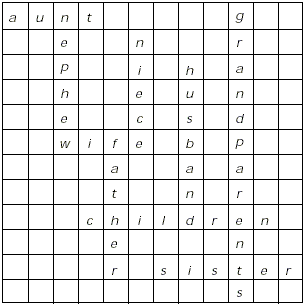
- Students form pairs or groups and then make a crossword puzzle grid of 12 by 12 lines.
- Students use words from the unit and try to fit in as many as possible on their grids. (Note: The example grid below uses words connected to family and relatives from Unit 5.)
- After ten minutes, stop the activity and find out who has the most words on the grid. Ask that student to read each word aloud and to spell each one; the rest of the class listens and circles the same words on their grids.
|
Back to Top
|
Game – Word Bingo
This activity is designed to be taught with Exercise 11, "Reading: Shop till you drop."
Time: 10–15 minutes. This activity reviews vocabulary and spelling, and practices listening for and writing down key words. It can easily be used with any unit.
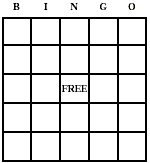
- Make up a list of 24 words from Unit 5. Then show students how to make a Bingo card on an 8½" X 11" sheet of paper with 25 spaces on it, like this:
- Dictate the words from your list: First, say the word and spell it. Then use it in a sentence, like this:
Teacher: Family. F-A-M-I-L-Y. There are three in my family.
- Students listen and write down each word inside a box in random order on their Bingo cards.
- One by one, randomly call out the words from your list. Students find each word on their card and circle it. (Note: Check the word off on your own list so that no words are repeated. This will also help when checking a student's card later, after he or she gets "Bingo.")
- The first student to get five circled words in a row in any direction (including the "Free" space) shouts "Bingo!" Ask the student to read aloud the five circled words. Check them against the original list. If all the words are correct, that student is the winner.
|
Back to Top
|
Car for sale
This activity is designed to be taught with Exercise 11, "Reading: Shop till you drop."
Time: 10–15 minutes. This creative and fun activity practices writing a description of a car.
Preparation: Cut out color magazine pictures of cars or other vehicles. (If the picture appears in an ad, cut out any text that accompanies it.) Plan to divide the class into small groups; each group needs one picture.
- Explain the activity: In groups, students write an ad for the car in the picture, using their own information. Write these cues on the board and explain or model how to use them with an extra picture of a car:
Information needed for a car ad
Model/Type of vehicle:
Year:
Miles/Kilometers:
Color:
Condition (excellent, good, fair, etc.):
Price:
Special features:
Person to contact:
Phone:
- Groups use the cues to prepare their ads. Go around the class and give help as needed.
- Groups take turns reading their ads to the class. The others ask questions to get more information. Are there any "serious" buyers?
- Hold a brief class discussion: Which vehicle would students most like to buy? Why?
|
Back to Top
|
|
|