|
|
|

|
Do You Like Jazz?
The activities below provide fun exercises for the entire class when you have extra time. They are designed to be taught with specific exercises in this unit. Click on an activity in the list below or scroll down the page.
|
|

Go to the Resources Page for This Unit |
Scrambled letters
This activity is designed to be taught with Exercise 2, "Word Power: Entertainment."
Time: 5–10 minutes. This activity can be used with any unit for a fun vocabulary review and spelling exercise.
Preparation: Near the end of a cycle, choose ten words and scramble the letters of each one. Use the Unit Summaries in the back of the Student's Book to help you. If possible, choose ten words that are related to one another in some way (e.g., words for jobs in Unit 2; words for clothing in Unit 3; all nouns).
- In class, write the scrambled words on the board. To make the task easier, give students the first letter:
| 1. |
d e n f i r |
(f ___________________________) |
| 2. |
t s a e p r n |
(p ___________________________) |
| 3. |
e t t u s n d |
(s ___________________________) |
| 4. |
e n m |
(m ___________________________) |
| 5. |
r e t e h |
(t ___________________________) |
| 6. |
l e a m |
(m ___________________________) |
| 7. |
g e n i l s |
(s ___________________________) |
| 8. |
s l a c s |
(c ___________________________) |
| 9. |
e w n o m |
(w ___________________________) |
| 10. |
k e n m i c a n |
(n ___________________________) |
- Pairs rearrange the letters to find the words. Check students' answers.
Answers
- friend
- parents
- student
- men
- there
- male
- single
- class
- women
- nickname
|
Back to Top
|
Likes and dislikes
This activity is designed to be taught with Exercise 4, "Grammar Focus: Yes/No and Wh-questions with do."
Time: 15–20 minutes. This activity practices Wh- and yes/no questions.
Preparation: During an earlier class, ask students to write three statements on a piece of paper about their likes and dislikes on the topics of music and entertainment –
for example:
I can't stand talk shows.
I like Mozart.
My favorite actor is Harrison Ford.
Collect the statements and use the information to make a class grid. In the first box on the grid, write the three sentences from one student (do not include the student's name). Continue by writing three more statements in the next box until all students' statements have been included. Make one photocopy for each student.
- Give each student a copy of the grid. Explain the task: Students move around the class trying to find out who wrote the information in each box on the grid. They do this by asking one another questions. When students find the correct person, they write down that student's name in the box on the grid.
- Model the task. Tell students to look at the first box on the grid. Elicit example questions and write them on the board:
Do you like talk shows?
Do you like Mozart?
What do you think of Harrison Ford?
- Set a time limit of about 15 minutes. Students get up and go around the class asking questions. Remind students to write down the correct student's name in each box.
- When time is up, find out who has written down the most names. Then check that all the names are correct by asking each student to read his or her statements aloud to the class.
|
Back to Top
|
Who am I?
This activity is designed to be taught with Exercise 6, "Entertainment Survey."
Time: 10–15 minutes. This activity practices yes/no questions.
Preparation: Cut out magazine pictures (one for each student ) of well-known people that students are sure to know (e.g., famous entertainers, TV personalities, politicians, people currently in the news).
- Introduce or review the names for different kinds of entertainers (e.g., actor, actress, singer, musician) and for other famous people (e.g., politician, government leader, president, prime minister, king, TV personality, talk show host).
- Ask each student to come to the front of the class. Pin or tape a picture to the student's back without him or her seeing it. If possible, use pictures of women for female students and pictures of men for male students.
- Explain the task: Each student tries to guess whose picture is on his or her back. Students can use only yes/no questions to find out who it is.
- Model the task by asking a student to pin a picture on your back (e.g., the picture here is of Boris Yeltsin):
Teacher: Am I an entertainer?
Student: No, you aren't.
Teacher: Am I a politician?
Student: Yes, you are.
Teacher: Do I live in North America?
Student: No, you don't.
Teacher: Do I speak Russian?
Student: Yes, you do.
Teacher: Am I President Yeltsin?
Student: Yes, you are!
- Now students move around the class trying to identify their pictures. When a student correctly guesses the person's name, he or she sits down.
- Stop the activity after about ten minutes. Find out how many students guessed their person's name correctly.
|
Back to Top
|
Let's go!
This activity is designed to be taught with Exercise 9, "Grammar Focus: Would; verb + to + verb."
Time: 20 minutes. This is a two-part exercise that practices writing descriptions of events in a city – using real information – and then extending invitations.
Preparation: Ask students to bring English-language newspapers to class for this task. If there are none available, students could translate information from other sources into English. Alternatively, you could bring newspapers or other local printed sources with information about events in your town or city and make copies for all students to use in class.
- Explain the first task: Students scan the newspaper for interesting local events. Then they choose three events and write short summaries about each one:
There is a classic Japanese movie at the Star Theater.
The movie is The Seven Samurai. It's on Thursday at 8 o'clock.
students should add other information as appropriate (e.g., type of movie, main actors, ticket price, location of the theater).
- Students work individually, in pairs, or in groups to write descriptions of three events. Move around the class and give help as needed. (Note: This first part could also be done for homework.)
- Explain the second task: Students work in pairs and take turns reading aloud their three descriptions to each other. Then they invite their partners to do something, using the information about their three events.
|
Back to Top
|
Game – Word Bingo
This activity is designed to be taught with Exercise 12, "Reading: The sound of music."
Time: 10–15 minutes. This activity reviews vocabulary and spelling, and practices listening for and writing down key words. It can easily be used with any unit.
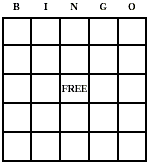
- Make up a list of 24 words from Unit 5. Then show students how to make a Bingo card on an 8½" X 11" sheet of paper with 25 spaces on it, like this:
- Dictate the words from your list: First, say the word and spell it. Then use it in a sentence, like this:
Teacher: Family. F-A-M-I-L-Y. There are three in my family.
- Students listen and write down each word inside a box in random order on their Bingo cards.
- One by one, randomly call out the words from your list. Students find each word on their card and circle it. (Note: Check the word off on your own list so that no words are repeated. This will also help when checking a student's card later, after he or she gets "Bingo.")
- The first student to get five circled words in a row in any direction (including the "Free" space) shouts "Bingo!" Ask the student to read aloud the five circled words. Check them against the original list. If all the words are correct, that student is the winner.
|
Back to Top
|
Crossword puzzle
This activity is designed to be taught with Exercise 12, "Reading: The sound of music." See also the new crossword puzzle created for Review of Units 1–4.
Time: 15 minutes. This activity is good for reviewing vocabulary in any unit and for practicing spelling.
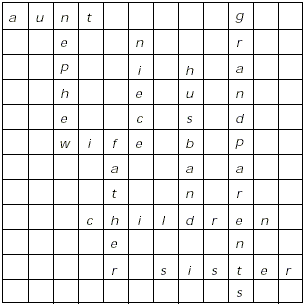
- Students form pairs or groups and then make a crossword puzzle grid of 12 by 12 lines.
- Students use words from the unit and try to fit in as many as possible on their grids. (Note: The example grid below uses words connected to family and relatives from Unit 5.)
- After ten minutes, stop the activity and find out who has the most words on the grid. Ask that student to read each word aloud and to spell each one; the rest of the class listens and circles the same words on their grids.
|
Back to Top
|
|
|