|
|
|

|
How Often Do You Exercise?
The activities below provide fun exercises for the entire class when you have extra time. They are designed to be taught with specific exercises in this unit. Click on an activity in the list below or scroll down the page.
|
|

Go to the Resources Page for This Unit |
In my free time
This activity is designed to be taught with Exercise 9, "Conversation: Describing exercise."
Time: 15 minutes. This activity practices the simple present tense with adverbs of frequency. Students try to identify classmates by finding out what they do in their free time.
- Write these cues on the board:
What I like to do in my free time
I like . . . (sports, music, TV, videos).
I . . . every day.
I usually/often/sometimes . . . in the evening.
I . . . on Saturday/Sunday.
For my summer vacation, I usually . . . .
- Ask students to use the cues to write a total of five sentences about themselves – each sentence on a separate index card or small piece of paper (e.g., 3" X 5"). Tell students not to write their names on their papers. Collect the papers, mix them up, and then give one to each student.
- Explain the activity: Students ask one another questions based on the information they have in the description on the piece of paper. When they find the person who fits the description, they write the student's name on it and keep it. Then they get another description. Whoever finds the most people is the winner.
- Elicit the kinds of questions students could ask and write some of them on the board for them to use as models.
- Set a time limit of about ten minutes. Students move around the class asking questions and matching students with descriptions. When time is up, find out who made the most matches.
|
Back to Top
|
Game – What's the question?
This activity is designed to be taught with Exercise 11, "Grammar Focus: Questions with how; short answers."
Time: 10–15 minutes. This activity reviews Wh-questions.
Preparation: Each student will need three blank cards.
- Divide the class into two teams – Teams A and B. (Note: This activity can also be done in groups.) Give each student three blank cards.
- Students think of three statements that could be answers to Wh-questions (e.g., She works in a zoo. He's a flight attendant for United. I study dance at UCLA.). Then students write one statement on each card. Walk around the class and give help when needed.
- Collect all of the students' cards and put them in a pile facedown.
- Team A starts: One student picks up a card and reads it aloud to a student from Team B. That student then tries to make a suitable Wh-question for it. Students on both teams decide whether the question is correct or not. If it is, Team B wins a point; if it isn't, a student from Team A tries to correct it. If the correction is acceptable, Team A gets the point instead. Keep a tally of the scores on the board. The team with the most points wins.
|
Back to Top
|
Question and answer
This activity is designed to be taught with Exercise 11, "Grammar Focus: Questions with how; short answers."
Time: 10 minutes. This activity practices asking questions about world geography or about your country; it also reviews comparative and superlative adjectives. This type of activity could be easily adapted for any unit's grammar and vocabulary.
Preparation: Make a set of Wh-questions and questions with how on cards; write one question on each card. Then make a corresponding set of answers on cards; write the answer to each question on a separate card – for example:
| Question cards |
Answer cards |
| What's the capital of France? |
|
|
| How cold is New Zealand in the winter? |
|
| It goes down to about 10º Celsius (50º Fahrenheit). |
|
| What the longest river in the world? |
|
|
Make enough question and answer cards so that half of the students have one question card each and the other half have one answer card each. (Note: In a small class, you may want to give more than one question or answer card to each student.) The questions should be about local geography, your country, or the world, and they should be relatively easy for students to answer.
- In class, mix up both sets of cards and hand out one card (either a question or an answer card) to each student.
- Explain the task: Students move around the class and try to match their questions and answers. To do this, they can either read their questions and answers aloud or they can use these phrases, like this:
Student 1: What's your question?
Student 2: (reads his or her question aloud)
Student 1: No, my answer doesn't match. (or) Yes, that matches my answer (reads answer aloud)!
- Set a time limit of about five minutes. When two students find a question and answer that match, they sit down.
- Check answers by having students read their questions and answers aloud to the rest of the class.
|
Back to Top
|
Game – Word Bingo
This activity is designed to be taught with Exercise 12, "Reading: Smart moves."
Time: 10–15 minutes. This activity reviews vocabulary and spelling, and practices listening for and writing down key words. It can easily be used with any unit.
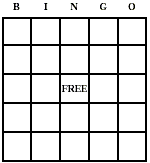
- Make up a list of 24 words from Unit 5. Then show students how to make a Bingo card on an 8½" X 11" sheet of paper with 25 spaces on it, like this:
- Dictate the words from your list: First, say the word and spell it. Then use it in a sentence, like this:
Teacher: Family. F-A-M-I-L-Y. There are three in my family.
- Students listen and write down each word inside a box in random order on their Bingo cards.
- One by one, randomly call out the words from your list. Students find each word on their card and circle it. (Note: Check the word off on your own list so that no words are repeated. This will also help when checking a student's card later, after he or she gets "Bingo.")
- The first student to get five circled words in a row in any direction (including the "Free" space) shouts "Bingo!" Ask the student to read aloud the five circled words. Check them against the original list. If all the words are correct, that student is the winner.
|
Back to Top
|
Crossword puzzle
This activity is designed to be taught with Exercise 12, "Reading: Smart moves." See also the new crossword puzzle created for Review of Units 5–8.
Time: 15 minutes. This activity is good for reviewing vocabulary in any unit and for practicing spelling.
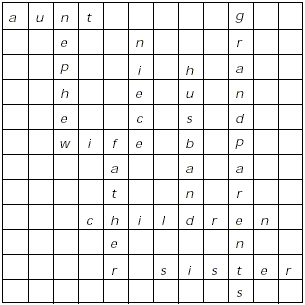
- Students form pairs or groups and then make a crossword puzzle grid of 12 by 12 lines.
- Students use words from the unit and try to fit in as many as possible on their grids. (Note: The example grid below uses words connected to family and relatives from Unit 5.)
- After ten minutes, stop the activity and find out who has the most words on the grid. Ask that student to read each word aloud and to spell each one; the rest of the class listens and circles the same words on their grids.
|
Back to Top
|
Game – Questions . . . and more questions
This activity is designed to be taught with Exercise 12, "Reading: Smart moves."
Time: 10–15 minutes. This activity reviews talking about routines and abilities using adverbs of frequency and questions with how and do.
Preparation: Each student will need five blank cards (e.g., index cards, paper from a small note pad).
- Divide the class into two teams – A and B (or into four groups designated as teams A, B, C, and D). Each student writes five statements describing his or her routine. Tell students to write one sentence on each card and to use an adverb of frequency in each sentence (e.g., I usually stay home on my day off./I work out five times a week.).
- Collect students' cards and put them in a pile facedown.
- Team A starts. One student takes a card and reads the statement to a student on Team B (e.g., "I go jogging twice a week."). That student on Team B tries to make a question from the statement (e.g., "How often do you usually go jogging?" or "How much time do you spend jogging?" or "Do you ever go jogging?").
- Students on both teams (or all four teams) decide if the question is correct. If it is, Team B gets a point. If it isn't, Team A gets a turn to make a question for the statement. If that question is correct, Team A gets the point instead.
- Keep a record of the team scores on the board. The team with the most points is the winner.
|
Back to Top
|
|
|