|
|
|

|
We Had a Great Time!
The activities below provide fun exercises for the entire class when you have extra time. They are designed to be taught with specific exercises in this unit. Click on an activity in the list below or scroll down the page.
|
|

Go to the Resources Page for This Unit |
Game – Tic-Tac-Toe
This activity is designed to be taught with Exercise 3, "Grammar Focus: Past tense."
Time: 5–10 minutes. This activity practices making past tense questions and statements with regular and irregular verbs. It can be adapted for use with any unit's verb forms or vocabulary.
- Draw a grid with nine squares on the board (i.e., 3 rows by 3 columns). Ask students to call out past tense verbs (e.g., drove, enjoyed, saw) and write them on the grid.
- Divide the class into two teams – Team X and Team O. Team X starts by choosing a verb and making either a question or a statement with it. If it is not correct, Team O gets a chance to use the same word in a question or statement. If Team O makes a correct sentence, write an O on the grid. Then it is Team O's turn. The game continues until one team gets tic-tac-toe (i.e., three Xs or Os together in a row, in a column, or diagonally through the grid).
- Optional: This game could also be played in pairs or groups, which would give each student more chances to make questions or sentences.
|
Back to Top
|
Game – Twenty questions
This activity is designed to be taught with Exercise 9, "Grammar Focus: Past tense of be."
Time: 10 minutes. In this popular game, students practice asking yes/ no questions in the simple present tense while trying to guess the names of famous living people.
- Students form groups. Explain the game: One student thinks of a famous person and then answers the group's questions with "Yes" or "No" about that person. The winner is either the student who correctly guesses the name of the person or the student who answers twenty questions before anyone in the group correctly guesses the name.
|
Back to Top
|
Chain story – A terrible day!
This activity is designed to be taught with Exercise 10, "Vacations."
Time: 10 minutes. This activity practices telling stories in the past tense.
- Students work in groups. Explain the task: Each group makes up several interesting stories about a terrible day when everything went wrong. One student starts the first story, and then the other students in the group take turns adding sentences to it.
- Model the task, like this:
Teacher: Yesterday was a terrible day! We went to the beach.
Student 1: There was no sun.
Student 2: And it rained for two hours.
Student 3: Then we went to a restaurant for lunch.
Student 4: The food was horrible there.
Student 1: And then . . . .
- Students form groups and do the task. Set a time limit of about five minutes. Go around the class and give help as needed.
- Each group chooses one of their stories. Then groups take turns telling their stories to the class. Which group told the best story?
|
Back to Top
|
Game – Word Bingo
This activity is designed to be taught with Exercise 13, "Reading: Vacation postcards."
Time: 10–15 minutes. This activity reviews vocabulary and spelling, and practices listening for and writing down key words. It can easily be used with any unit.
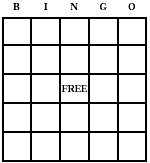
- Make up a list of 24 words from Unit 5. Then show students how to make a Bingo card on an 8½" X 11" sheet of paper with 25 spaces on it, like this:
- Dictate the words from your list: First, say the word and spell it. Then use it in a sentence, like this:
Teacher: Family. F-A-M-I-L-Y. There are three in my family.
- Students listen and write down each word inside a box in random order on their Bingo cards.
- One by one, randomly call out the words from your list. Students find each word on their card and circle it. (Note: Check the word off on your own list so that no words are repeated. This will also help when checking a student's card later, after he or she gets "Bingo.")
- The first student to get five circled words in a row in any direction (including the "Free" space) shouts "Bingo!" Ask the student to read aloud the five circled words. Check them against the original list. If all the words are correct, that student is the winner.
|
Back to Top
|
Crossword puzzle
This activity is designed to be taught with Exercise 13, "Reading: Vacation postcards." See also the new crossword puzzle created for Review of Units 5–8.
Time: 15 minutes. This activity is good for reviewing vocabulary in any unit and for practicing spelling.
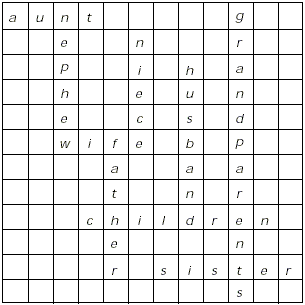
- Students form pairs or groups and then make a crossword puzzle grid of 12 by 12 lines.
- Students use words from the unit and try to fit in as many as possible on their grids. (Note: The example grid below uses words connected to family and relatives from Unit 5.)
- After ten minutes, stop the activity and find out who has the most words on the grid. Ask that student to read each word aloud and to spell each one; the rest of the class listens and circles the same words on their grids.
|
Back to Top
|
Picture story
This activity is designed to be taught with Exercise 13, "Reading: Vacation postcards."
Time: 15–20 minutes. This creative storytelling activity practices the past tense.
Preparation: Ask each student to bring two or three pictures from magazines or newspapers showing interesting people, actions, scenes, and events. The pictures do not need to be related.
- Students form small groups. Tell them to pool their pictures and to lay them out on a desk. They have to link the pictures to tell a story. Encourage students to be creative in making up interesting or unusual stories. If necessary, model how a story might begin by showing how some of the pictures from one group could be linked together.
- Set a time limit of about ten minutes. Move around the class and give help as needed.
- As a class activity, groups take turns telling their stories and the rest of the students ask them questions. After all the groups have finished, take a class vote: Which group told the most interesting story?
|
Back to Top
|
Vacation snapshots and souvenirs
This activity is designed to be taught with Exercise 13, "Reading: Vacation postcards."
Preparation: Ask students to bring real vacation photos along with any other things that they have from a trip (e.g., guidebooks, brochures, souvenirs) to share with others in the class.
- Students form small groups. Then they take turns sharing their photos and other souvenirs while telling one another about their vacations.
|
Back to Top
|
|
|