|
|
|

|
It Really Works!
The activities below provide fun exercises for the entire class when you have extra time. They are designed to be taught with specific exercises in this unit. Click on an activity in the list below or scroll down the page.
|
|

Go to the Resources Page for This Unit |
Getting to know you – better!
This activity is designed to be taught with Exercise 3, "Grammar Focus: Infinitive complements."
Time: 10–15 minutes. This fun activity allows students to get to know their classmates better by asking questions about their past experiences, which may include some regular types of experiences along with some rather unusual ones!
- With the whole class, brainstorm some fun and unusual topics. Write as many phrases as possible on the board using past participles, such as:
| won a prize |
| driven in a snowstorm |
| see a ghost |
| met someone from Russia |
| gone on a safari |
| missed the last train home |
| ridden a donkey |
| gone to a party alone |
| climbed Mt. Fuji |
| eaten spicy Indian food |
- Class activity: Students take turns asking classmates questions starting with "Have you ever . . . ?"
Student 1: Carlos, have you ever won a prize?
Student 2: Yes, I have. I won a speech contest once. Jill, have you ever seen a ghost?
Student 3: Well, I'm not really sure, but one night I saw . . . .
|
Back to Top
|
Game – Simon Says
This activity is designed to be taught with Exercise 3, "Grammar Focus: Infinitive complements."
Time: 5–10 minutes. Most students will enjoy this game, which reviews parts of the body and practices basic action verbs. This game could also be adapted to other units with different types of action verbs (e.g., Unit 4: sing, play an instrument, go out, listen to).
- Explain the rules of the game: Students stand up. You give a series of commands – one at a time, with most of them starting with the phrase "Simon says," like this:
Teacher: Simon says touch your toes.
The class must obey these commands. Sometimes, however, you give a command without "Simon says":
Teacher: Touch your toes.
When students hear a command without "Simon says," they shouldn't do anything. Tell students that if they do an action without hearing "Simon says" or if they do the wrong action, they're out and they have to sit down. The last student standing is the winner and gets to lead the next game.
|
Back to Top
|
Absent again!
This activity is designed to be taught with Exercise 3, "Grammar Focus: Infinitive complements."
Time: 10–15 minutes. This practical activity shows students how to make telephone calls and give medical excuses for when they must be absent from class.
- Explain the activity: One student is calling the teacher or the school office to give a medical excuse for not being able to come to school. Encourage students to think of some interesting excuses for being absent. Model the task with a volunteer, like this:
Teacher: Hello? This is . . . (giving own name or school's name). How can I help you?
Student: Hello. This is Chuck Chen. I'm sorry I can't come to (giving name of teacher or course number – e.g., Ms. Johnson's, English 100A) class today.
Teacher: Oh? I'm sorry to hear that, Chuck. What's wrong?
Student: Well, I went skydiving with some friends on Saturday and I hurt my ankle.
Teacher: Oh, that's too bad! Well, I hope you feel better soon. Take care now!
Student: Thanks. Good-bye.
Teacher: Bye.
- Pairs choose roles and then sit back-to-back to practice making telephone calls. Go around the class and give help as needed.
- Students switch roles and try the activity again.
- Optional: Ask pairs to volunteer to perform the activity in the front of the class.
|
Back to Top
|
Game – Word Bingo
This activity is designed to be taught with Exercise 12, "Reading: Grandma knows best!"
Time: 10–15 minutes. This activity reviews vocabulary and spelling, and practices listening for and writing down key words. It can easily be used with any unit.
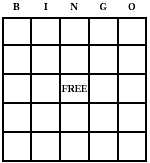
- Make up a list of 24 words from Unit 5. Then show students how to make a Bingo card on an 8½" X 11" sheet of paper with 25 spaces on it, like this:
- Dictate the words from your list: First, say the word and spell it. Then use it in a sentence, like this:
Teacher: Family. F-A-M-I-L-Y. There are three in my family.
- Students listen and write down each word inside a box in random order on their Bingo cards.
- One by one, randomly call out the words from your list. Students find each word on their card and circle it. (Note: Check the word off on your own list so that no words are repeated. This will also help when checking a student's card later, after he or she gets "Bingo.")
- The first student to get five circled words in a row in any direction (including the "Free" space) shouts "Bingo!" Ask the student to read aloud the five circled words. Check them against the original list. If all the words are correct, that student is the winner.
|
Back to Top
|
Crossword puzzle
This activity is designed to be taught with Exercise 12, "Reading: Grandma knows best!" See also the new crossword puzzle created for Review of Units 9–12.
Time: 15 minutes. This activity is good for reviewing vocabulary in any unit and for practicing spelling.
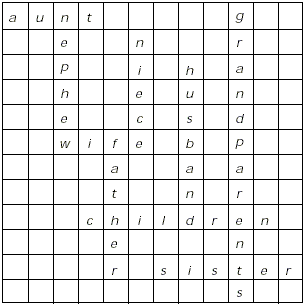
- Students form pairs or groups and then make a crossword puzzle grid of 12 by 12 lines.
- Students use words from the unit and try to fit in as many as possible on their grids. (Note: The example grid below uses words connected to family and relatives from Unit 5.)
- After ten minutes, stop the activity and find out who has the most words on the grid. Ask that student to read each word aloud and to spell each one; the rest of the class listens and circles the same words on their grids.
|
Back to Top
|
Wonder drug
This activity is designed to be taught with Exercise 12, "Reading: Grandma knows best!"
Time: 20–25 minutes. This fun and creative activity has students prepare a commercial for a new "miracle" drug.
- Explain the task: Students work in small groups and think up a new wonder drug that can be used to solve an interesting "problem" (e.g., improve one's memory; make a person younger or taller; save someone from having to do any exercise). Students prepare a 30-second commercial for radio or TV.
- Write these questions on the board to help students plan their commercials:
What is the drug for?
What does it look like?
What's it called?
Is this for a TV or for a radio commercial? Why?
How much does it cost?
Where do you buy it?
How often is it used?
- Set a time limit of about 15 minutes. Groups use their answers to the questions on the board to create their 30-second commercials. One student is the group secretary and records the final script. Go around the class, giving help and encouragement.
- As a class activity, groups read (for radio) or perform (for TV) their commercials in front of the room. Then let the class decide (1) which group has the most interesting wonder drug, and (2) which group has the best commercial.
|
Back to Top
|
|
|