|
|
|

|
I'm Going to See a Musical.
The activities below provide fun exercises for the entire class when you have extra time. They are designed to be taught with specific exercises in this unit. Click on an activity in the list below or scroll down the page.
|
|

Go to the Resources Page for This Unit |
Are you doing anything on Saturday?
This activity is designed to be taught with Exercise 3, "Grammar Focus: Future with present continuous and be going to."
Time: 10–15 minutes. This role play practices extending, accepting, and declining invitations.
Preparation: Students bring in information from English language newspapers and magazines about local events (e.g., movies, concerts, sports events, fairs).
- Explain the activity: Students work in pairs (or groups) and practice inviting each other to real events in the city or town by using local English newspapers and magazines. One student tells a partner about an event that he or she would like to see and then invites the partner to it. The partner either accepts or declines the invitation.
- If necessary, explain that this activity is just a role play – i.e., students should not feel obliged to actually go out with someone in the class as a result of this practice.
|
Back to Top
|
A fantastic weekend!
This activity is designed to be taught with Exercise 6, "Conversation: Telephone messages."
Time: 15–20 minutes. This fun activity practices planning weekend activities for visiting guests.
- Explain the situation: Two wealthy friends are coming to visit you this weekend. They have very expensive tastes and like to enjoy the best of everything. Of course, they will pay all expenses, including yours.
- Students work in groups of four. If students live in a big city, they should plan activities for that city. However, if they are in a small town, they should make plans to stay in the nearest big city. Write this information on the board:
| Things to think about for the weekend |
| transportation |
|
sightseeing |
|
shopping |
| hotel |
|
entertainment |
|
restaurants |
Weekend itinerary
Friday evening (guests arrive at 6 P.M.)
Saturday morning, afternoon, and evening
Sunday morning and afternoon (guests leave at 3 P.M.)
- Groups plan their weekends. Go around the class and give help and encouragement as needed.
- Ask groups to report their weekend plans. Encourage others to ask questions in order to find out more details.
|
Back to Top
|
Game – Word Bingo
This activity is designed to be taught with Exercise 12, "Reading: Ways to keep phone calls short ."
Time: 10–15 minutes. This activity reviews vocabulary and spelling, and practices listening for and writing down key words. It can easily be used with any unit.
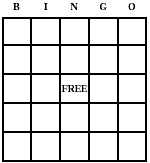
- Make up a list of 24 words from Unit 5. Then show students how to make a Bingo card on an 8½" X 11" sheet of paper with 25 spaces on it, like this:
- Dictate the words from your list: First, say the word and spell it. Then use it in a sentence, like this:
Teacher: Family. F-A-M-I-L-Y. There are three in my family.
- Students listen and write down each word inside a box in random order on their Bingo cards.
- One by one, randomly call out the words from your list. Students find each word on their card and circle it. (Note: Check the word off on your own list so that no words are repeated. This will also help when checking a student's card later, after he or she gets "Bingo.")
- The first student to get five circled words in a row in any direction (including the "Free" space) shouts "Bingo!" Ask the student to read aloud the five circled words. Check them against the original list. If all the words are correct, that student is the winner.
|
Back to Top
|
Crossword puzzle
This activity is designed to be taught with Exercise 12, "Reading: Ways to keep phone calls short ." See also the new crossword puzzle created for Review of Units 13–16.
Time: 15 minutes. This activity is good for reviewing vocabulary in any unit and for practicing spelling.
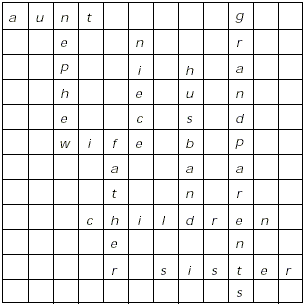
- Students form pairs or groups and then make a crossword puzzle grid of 12 by 12 lines.
- Students use words from the unit and try to fit in as many as possible on their grids. (Note: The example grid below uses words connected to family and relatives from Unit 5.)
- After ten minutes, stop the activity and find out who has the most words on the grid. Ask that student to read each word aloud and to spell each one; the rest of the class listens and circles the same words on their grids.
|
Back to Top
|
Sentence-making contest
This activity is designed to be taught with Exercise 12, "Reading: Ways to keep phone calls short ."
Time: 10–15 minutes. This activity reviews describing people, their careers, and changes in their lives.
Preparation: In the class before the activity is done, each student brings one color magazine picture showing several people doing various activities. Collect the pictures and choose the best ones for this task. The number of pictures should equal the number of groups (e.g., class size 20 = 4 students in each group = 5 pictures needed). Then number each picture (e.g., #1, #2).
- Group work: Give each group a picture and explain the game: Students try to make as many different sentences as they can – in three minutes – about the people in the picture. On a separate piece of paper, the group secretary writes down the picture's number and every sentence the group can think up.
- When the first three-minute time limit is up, groups exchange pictures (clockwise around the class) and do the task again with the next picture. On the same piece of paper, the group secretary again writes down the picture's number and all the sentences that the group forms. Continue the activity until every group has written sentences for each picture passed around.
- Class activity: Now find out which group has written the most sentences for each picture. Then that group holds up the picture while the group secretary reads their sentences aloud to the class.
|
Back to Top
|
|
|