|
|
|

|
I've Never Heard of That!
The activities below provide fun exercises for the entire class when you have extra time. They are designed to be taught with specific exercises in this unit. Click on an activity in the list below or scroll down the page.
|
|

Go to the Resources Page for This Unit |
Verb contest
This activity is designed to be taught with Exercise 4, "Grammar Focus: Simple past vs. present perfect."
Time: 15 minutes. This activity provides an opportunity for students to review the spelling of verb forms – here, the simple past and the past participle. This contest can easily be conducted with another focus (e.g., singular and plural nouns; comparative forms of adjectives).
Preparation: Make a list of verbs for the contest. Choose verbs from the current unit and from previous units, focusing on verbs that have irregular forms (see the appendix at the back of the Student's Book for a handy list of irregular verbs). You will need the same number of verbs for each group of students (e.g., 5 groups 5 words = 25 words total needed).
Suggested verb list:
| build |
|
eat |
|
keep |
|
run |
|
stand |
| buy |
|
get |
|
leave |
|
see |
|
take |
| catch |
|
go |
|
make |
|
sell |
|
teach |
| come |
|
grow |
|
meet |
|
sit |
|
wear |
| do |
|
have |
|
pay |
|
speak |
|
write |
- Books closed. Divide the class into groups and assign them letters (e.g., Group A, Group B). Then choose a verb from your list and ask Group A how to say and spell the simple past and past participle. Give the group a few seconds to discuss how each verb is spelled. (Note: Make sure that each student in a group gets a turn to spell a word aloud.) If both forms are correct, the group gets two points; if only one is correct, the group gets one point and the next group gets a chance for a point. If both forms are incorrect, spell the words correctly for the class and go on to the next group and the next word. For example:
Teacher: OK, Group A starts. Here's the first verb: build. What's the past tense of build?
Student 1: Built. B-U-I-L-T.
Teacher: Correct. That's one point. Now what's the past participle?
Student 2: Built. B-U-I-L-T.
Teacher: Correct. Two points. Now Group B . . . .
- Continue in this way until you have used all the verbs in the list and each group has had the same number of turns. The winner is the group with the most points.
|
Back to Top
|
Crossword puzzle
This activity is designed to be taught with Exercise 7, "Word Power: Cooking methods." See also the new crossword puzzle created for Review of Units 1–4 in the Puzzle Corner.
Time: 15 minutes. This activity is good for reviewing vocabulary in any unit and for practicing spelling.
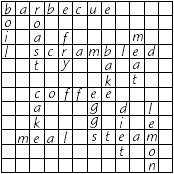
- Each student makes a crossword puzzle grid of 12 by 12 lines.
- Students use words from the unit and try to fit as many as possible on their grids. (Note: The following example grid uses words connected to food and cooking from Unit 4.)
- After ten minutes, stop the activity and find out who has the most words on the grid. Ask that student to read each word aloud and to spell each one; the rest of the class listens and circles any of the same words they may have on their grids.
|
Back to Top
|
At the potluck
This activity is designed to be taught with Exercise 11, "Writing: Recipes."
Time: 15 minutes. This chain-story game practices the vocabulary for food items. It can be done either with the whole class or as a group activity (with large groups of five to ten students each).
- Explain that a potluck is a party where each guest brings a dish to share with others. Then tell how to play the game: Students imagine that they have just been to a potluck and they have to say what they ate for dinner. They must use only the English names of food items during the game. One student starts the game, like this:
Student 1: At the potluck, I ate some fried chicken.
The next student repeats what the first student said and adds one more food item:
Student 2: At the potluck, I ate some fried chicken and a turkey sandwich.
Student 3: At the potluck, I ate some fried chicken, a turkey sandwich, and . . . .
Continue in this way until everyone in the group or the class has had a turn.
|
Back to Top
|
Once in a lifetime
This activity is designed to be taught with Exercise 12, "Reading: Eating for energy."
Time: 20 minutes. This activity provides a fun way of reviewing the present perfect. Here, students work in groups and prepare a questionnaire focused on unusual activities. Then students independently interview classmates from other groups to find out who has done any of the activities.
- Divide the class into groups. Tell the groups to make up a questionnaire that contains ten questions about unusual activities. Each student writes down the group's questions on a piece of paper (i.e., each member of the group should have his or her own copy of the questionnaire) to use later in the activity. In this practice, tell students to use the present perfect – for example:
Have you ever had a pet snake?
Have you ever seen a TV personality on the street or in a restaurant?
Have you ever gone skydiving?
- Students get up and move around the class, asking the questions from their group's questionnaire. If anyone answers "Yes" to a question, students should write down that person's name and ask a few follow-up questions to get some more details.
- Stop the activity after about ten minutes. Ask students to tell the class who answered "Yes" to any of their questions and to report what the person said. Encourage the rest of the class to ask both the interviewer and the interviewee additional questions.
|
Back to Top
|
Game – What's the question?
This activity is designed to be taught with Exercise 12, "Reading: Eating for energy."
Time: 10–15 minutes. This activity reviews yes/no questions with the simple past and present perfect.
Preparation: Each student will need three blank cards.
- Divide the class into two teams – A and B. Give each student three blank cards.
- Students think of three statements that could be answers to questions in the simple past or present perfect (e.g., Yes, I've been to New York twice. No, I didn't have time to eat breakfast this morning.). Then students write one statement on each card. Walk around and give help as needed.
- Collect all the cards and put them in a pile facedown.
- Team A starts: One student picks up a card and reads it aloud to a student from Team B. That student tries to make a suitable question for it. Students on both teams decide whether the question is correct. If it is, Team B wins a point; if it isn't, a student from Team A tries to correct it. If the correction is acceptable, Team A gets the point instead. Keep score on the board. The team with the most points wins.
|
Back to Top
|
|
|