|
|
|

|
Sure. No Problem!
The activities below provide fun exercises for the entire class when you have extra time. They are designed to be taught with specific exercises in this unit. Click on an activity in the list below or scroll down the page.
|
|

Go to the Resources Page for This Unit |
Charades
This activity is designed to be taught with Exercise 5, "Word Power: Household chores."
Time: 20 minutes. This activity reviews the vocabulary for any activity or situation; i.e., it can be adapted for any unit.
- Students form groups. Each group thinks of several situations (e.g., ordering in a restaurant; eating an ice cream cone; playing the guitar; vacuuming) – one situation for each member of the group to mime.
- Groups take turns miming their situations in front of the class. Remind each group not to speak while performing; they can only nod their heads when another group guesses the situation correctly. The other groups call out their guesses. Keep score on the board: Each group that guesses correctly gets one point.
|
Back to Top
|
Word associations
This activity is designed to be taught with Exercise 8, "Apologies."
Time: 10–15 minutes. This activity extends and recycles students' vocabulary, with a focus on nouns. (Note: This activity could be adapted to any unit and the focus changed to adjectives, verbs, phrases, and so on.)
Preparation: Choose some nouns from this unit, or a previous one, with which students can readily make some associations.
- Explain the activity: You will call out a noun, and students have to quickly say words that they associate with it.
- Model the activity by seeing how many words students can think of that relate to a common topic, such as pets. For example:
Teacher: Pets.
Student 1: Dogs.
Student 2: Birds.
Student 3: Birdcages.
Student 4: Aquariums.
- Divide the class into groups. Tell each group to choose a secretary, who also gets to take turns giving word associations during the activity. Now call out one word. Each secretary writes it down and then continues to add each word that his or her group comes up with. Set a time limit of about three minutes.
- Call on groups to read out their words. The group with the greatest number of word associations is the winner.
|
Back to Top
|
Game – Word Bingo
This activity is designed to be taught with Exercise 11, "Reading: Summer in the country."
Time: 10–15 minutes. This activity reviews vocabulary and spelling, and practices listening for and writing down key words. It can easily be used with any unit.
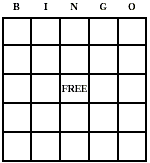
- Make up a list of twenty-four words from Unit 6. Then show students how to make a Bingo card on an 8½ X 11-inch sheet of paper with 25 spaces on it, like this:
- Dictate the words from your list: First, say the word and spell it. Then use it in a sentence, like this:
Teacher: Neighbor. N-E-I-G-H-B-O-R. My neighbor cuts his lawn twice a week.
- Students listen and write each word inside a box in random order on their Bingo cards.
- One by one, randomly call out the words from your list. Students find each word on their card and circle it. (Note: Check the word off on your own list so that no words are repeated. This will also help when checking a student's card later, after he or she gets "Bingo.")
- The first student to get five circled words in a row in any direction (including the "Free" space) shouts "Bingo!" Ask the student to read aloud the five circled words. Check them against the original list. If all the words are correct, that student is the winner.
|
Back to Top
|
Terrible neighbors
This activity is designed to be taught with Exercise 11, "Reading: Summer in the country."
Time: 15–20 minutes. This activity practices making and responding to requests, and complaining.
- Explain the situation: Students imagine they have terrible neighbors and prepare a list of things their neighbors do that really bother them.
- Divide the class into groups, who first brainstorm and then make up a list of six problems to complain about – for example:
My neighbors get home late every night and make a lot of noise. They always wake me up.
- Then students from different groups form pairs to role play each situation:
Student 1: Say, you really make a lot of noise every night when you come home. You always wake me up! Could you please be a little quieter at night?
Student 2: Gee, I'm sorry. I didn't know I was bothering you. I'll try to be quiet from now on.
Student 1: Thanks.
|
Back to Top
|
|
|