|
|
|

|
Back to the Future
The activities below provide fun exercises for the entire class when you have extra time. They are designed to be taught with specific exercises in this unit. Click on an activity in the list below or scroll down the page.
|
|

Go to the Resources Page for This Unit |
What a time!
This activity is designed to be taught with Exercise 3, "Grammar Focus: Time contrasts."
Time: 15 minutes. This activity gives further practice in making statements with time phrases.
- Divide the class into two large groups – Group A and Group B. Explain the activity: One student in Group A begins by calling out a time phrase (e.g., "Soon." "In the past."). Then a student in Group B must use it in a sentence with the correct verb tense (e.g., "Soon there will be another election for U.S. president."). (Note: In both groups, make sure students take turns in giving the times cues and in making up sentences.)
- Elicit some time phrases and write them on the board for the groups to use. For example:
| Past |
|
Present |
|
Future |
In the past
In the nineteenth century
A hundred years ago
In the 1960s |
|
These days
Nowadays
Today
This year |
|
In ten years
In the next hundred years
In the twenty-first century
In the future
In a year
Soon |
- Ask for a volunteer to be the timekeeper to keep a ten-second time limit for each response.
- Now Group A begins by giving a time cue. One student in Group B must use it in a sentence with suitable information and the correct verb form. However, if that student cannot come up with a sentence within the time limit, a student from Group A gets a chance instead. Keep score on the board: one point for each complete sentence.
- Stop the activity after ten minutes. Which group has the most points?
|
Back to Top
|
Think fast!
This activity is designed to be taught with Exercise 10, "Word Power: Consequences."
Time: 5–10 minutes. The goal of this activity is to have students practice making statements or asking questions with pre-selected vocabulary. It provides a fun review of vocabulary and of grammar. This could be done in a group or as a whole class activity. (Note: This activity could be adapted for use with any unit's vocabulary and grammar points.)
Preparation: Choose words from this unit or other words that would be useful for students to review (e.g., in Unit 1, Cycle 1: verb tense – the past tense; verbs – Rollerblade, move, study; nouns – English, countries, immigrants).
- Model how the activity works: Give the class a word and then call on one student to use the word in a statement or in a question; designate the verb tense if that is also a focus. For example:
Teacher: Make a statement in the past tense with the verb move. John.
Student 1: I moved to the United States in 1997.
(Note: Then this student calls out the name of another student , who makes the next sentence.)
Student 1: Hanako?
Student 2: My parents moved to Rio last year.
- See how far students can keep the game going before giving them another word, tense, or type of structure (e.g., question, statement).
|
Back to Top
|
Game – Word Bingo
This activity is designed to be taught with Exercise 10, "Word Power: Consequences."
Time: 10–15 minutes. This activity reviews vocabulary and spelling, and practices listening for and writing down key words. It can easily be used with any unit.
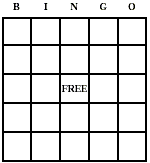
- Make up a list of twenty-four words from Unit 6. Then show students how to make a Bingo card on an 8½ X 11-inch sheet of paper with 25 spaces on it, like this:
- Dictate the words from your list: First, say the word and spell it. Then use it in a sentence, like this:
Teacher: Neighbor. N-E-I-G-H-B-O-R. My neighbor cuts his lawn twice a week.
- Students listen and write each word inside a box in random order on their Bingo cards.
- One by one, randomly call out the words from your list. Students find each word on their card and circle it. (Note: Check the word off on your own list so that no words are repeated. This will also help when checking a student's card later, after he or she gets "Bingo.")
- The first student to get five circled words in a row in any direction (including the "Free" space) shouts "Bingo!" Ask the student to read aloud the five circled words. Check them against the original list. If all the words are correct, that student is the winner.
|
Back to Top
|
Word associations
This activity is designed to be taught with Exercise 11, "Unexpected Consequences."
Time: 10–15 minutes. This activity extends and recycles students' vocabulary, with a focus on nouns. (Note: This activity could be adapted to any unit and the focus changed to adjectives, verbs, phrases, and so on.)
Preparation: Choose some nouns from this unit, or a previous one, with which students can readily make some associations.
- Explain the activity: You will call out a noun, and students have to quickly say words that they associate with it.
- Model the activity by seeing how many words students can think of that relate to a common topic, such as pets. For example:
Teacher: Pets.
Student 1: Dogs.
Student 2: Birds.
Student 3: Birdcages.
Student 4: Aquariums.
- Divide the class into groups. Tell each group to choose a secretary, who also gets to take turns giving word associations during the activity. Now call out one word. Each secretary writes it down and then continues to add each word that his or her group comes up with. Set a time limit of about three minutes.
- Call on groups to read out their words. The group with the greatest number of word associations is the winner.
|
Back to Top
|
How I've changed!
This activity is designed to be taught with Exercise 12, "Reading: Are you in love?"
Time: 15–20 minutes. This activity practices comparing people's abilities now with their abilities either five or ten years ago. Students practice using the time contrasts presented in Exercise 3, but in a more personalized context.
- Ask students to write down two lists: one list of ten things they do now that they didn't do five or ten years ago, and another list of ten things they used to do that they aren't able to do now. Write these examples on the board:
Present
1. I use a computer every day now. I didn't know how to use one ten years ago.
Past
1. I used to play the piano when I was a child. I don't anymore, though.
- Students write their lists individually and then compare their statements in pairs. Encourage students to ask follow-up questions like these:
Student 1: I speak German pretty well now. I studied it in high school and college.
Student 2: Oh, really? Have you been to Germany?
|
Back to Top
|
|
|