|
|
|

|
It's Really Worth Seeing!
The activities below provide fun exercises for the entire class when you have extra time. They are designed to be taught with specific exercises in this unit. Click on an activity in the list below or scroll down the page.
|
|

Go to the Resources Page for This Unit |
One word a minute
This activity is designed to be taught with Exercise 7, "Word Power: Features of countries."
Time: 10–15 minutes. This activity reviews any unit's vocabulary and practices making sentences with pre-selected words. It could be used at any time for a quick warm-up activity or just a fun way to review vocabulary.
Preparation: Make a list of ten words from this unit or any previous unit or units. (Note: See the Key Vocabulary in the Unit Summaries, located at the back of the Student's Book.)
- Students form groups. Name each group with a letter or number (e.g., Group A or Group 1) and write the groups' names on the board for keeping score.
- Explain the activity: You will read a word aloud to the class. Within the next minute, groups compete with one another trying to think of as many sentences as possible using the word. Each time a group (or individual students within a group) comes up with a sentence, one of the students in that group raises his or her hand; then he or she says it to the rest of the class when called upon by you. If the sentence is correct, that group gets one point.
- Give the class this example of how to play:
| Teacher: |
|
Flower. F-L-O-W-E-R. |
| |
"A rose is a flower." |
| |
"Flowers smell sweet." |
| |
"What's your favorite flower?" |
| |
"Where can you buy flowers around here?" |
| |
"Who do you sometimes give flowers to?" |
- Start the activity by reading aloud the first word on your list. A student from any group can raise his or her hand to make a sentence using that word. Continue for one minute, keeping score on the board. Then read the next word from your list. After ten minutes or ten words – whichever comes first – the group with the most points is the winner.
|
Back to Top
|
People and places
This activity is designed to be taught with Exercise 10, "What Do You Know?"
Time: 10–15 minutes. This activity gives further practice in using passives to describe situations.
- Explain the activity: Students will get a situation (e.g., in a hotel, on an airplane), and they must make as many statements as they can about it while using passives with or without by.
- Model the task by giving this example situation: In a department store. Then ask students to think of things that are done or that take place in that kind of place. Remind them to think of sentences using the passive. Write their suggestions on the board, like this:
In a department store
Clothes and shoes are sold there.
Food is served in its restaurant.
Uniforms are sometimes worn by the salesclerks.
Store sales are held at least once a year.
Expensive items are usually kept in glass cases.
- Now write the following situations on the board and ask students to think about them or other situations they can come up with:
| in a hotel |
|
at a school or university |
| on an airplane |
|
in a restaurant |
| at a bank |
|
in a supermarket |
- Students work in pairs or groups. Tell them to choose three situations to discuss and to write down their sentences for each one. Set a time limit of ten minutes. Go around and give help as needed.
- Call on students to read aloud some of the sentences they wrote for various situations. Which pair or group wrote the most sentences?
|
Back to Top
|
Question and answer
This activity is designed to be taught with Exercise 11, "Listening."
Time: 10 minutes. This activity practices asking questions about world geography or about students' own countries; it also reviews comparative and superlative adjectives. This type of activity could be easily adapted for any unit's grammar and vocabulary.
Preparation: Make a set of Wh-questions on cards; write one question on each card. Then make a corresponding set of answer cards; write the answer to each question on a separate card – for example:
Question cards
What's the capital of Spain?
What's the longest river in the world?
Answer cards
Make enough question and answer cards so that half of the students have one question card each and the other half have one answer card each. (Note: In a small class, you may want to give more than one question or answer card to each student.) The questions should be about local geography, your country, or the world, and they should be relatively easy for students to answer.
- In class, mix up both sets of cards and hand one card (either a question or an answer card) to each student.
- Explain the task: Students move around the class and try to match their questions and answers. To do this, they can read their questions and answers aloud, like this:
Student 1: What's your question?
Student 2: (reads his or her question aloud)
Student 1: No, my answer doesn't match. (or) Yes. That matches my answer (reads answer aloud)!
- Set a time limit of five minutes. When two students find a question and an answer that match, they sit down.
- Check answers by having students read their questions and answers aloud to the rest of the class.
|
Back to Top
|
Did you know . . . ?
This activity is designed to be taught with Exercise 13, "Reading: Seven modern wonders of the world."
Time: 15–20 minutes. This writing activity practices describing cities or countries, using both active and passive sentences. (Note: If you are teaching a heterogeneous class with enough students from the same country to form a group, you may prefer to have those students choose to write about a city in their country or about the country itself.)
- Explain that students work in groups to describe a certain city or country that they all know something about. The goal of this activity is for groups to think up and then write down as many sentences as they can within ten minutes.
- Model the task by writing the following example on the board (without the underlining):
Did you know . . . ?
Did you know that Australia is the only country alone on its own continent? It is located in the Southern Hemisphere. It was founded by settlers from Britain. It's not a very crowded place. The capital is located in Canberra. The biggest city is Sydney. The Sydney Opera House is located there. It's a very famous building. Many minerals are found in Australia. A lot of wool is exported from Australia to other places.
- Elicit additional sentences about Australia and write them on the board. Then point out which sentences contain passives (see underlined passives in the example above). Encourage students to use passives in this activity.
- Students form groups and choose a city or country to write about; give them a minute or so to do this. Tell groups to appoint a group secretary to write down all of their sentences or, better yet, have each student in the group write them down. Then set the time limit of ten minutes. Move around the class and give feedback.
- When time is up, groups take turns reading their sentences to the class. Which group has the most sentences?
|
Back to Top
|
Spelling contest
This activity is designed to be taught with Exercise 13, "Reading: Seven modern wonders of the world."
Time: 10–15 minutes. This activity provides an opportunity to check students' spelling and to review vocabulary from this and earlier units. It can be done at any time during the course. (Note: This game is similar to the Verb contest on page 131.)
Preparation: Choose a list of words for the contest. For this activity, students work in groups; between eight and ten words are needed for each group.
- Divide the class into groups of four or five and assign each group a letter (i.e., Group A, Group B, and so on).
- Choose a word from your list and present it like this: (1) Read the word aloud. (2) Use it in a short, simple sentence. (3) Then repeat the word by asking a group "How do you spell . . . ?" Give the group a few seconds to confer quietly on how the word might be spelled. Then one student from the group spells out the word. (Note: Students should take turns spelling the words aloud.)
- If the spelling is correct, that groups gets a point; if it's wrong, ask the next group (e.g., Group B) to spell it. If no group can spell the word correctly, spell it for the class, write it on the board, and then go on to the next one.
- Continue in this way, giving each group an equal number of opportunities to spell words. The group that has the most points is the winner.
|
Back to Top
|
Crossword puzzle
This activity is designed to be taught with Exercise 13, "Reading: Seven modern wonders of the world."See also the new crossword puzzle created for Review of Units 9–12 in the Puzzle Corner.
Time: 15 minutes. This activity is good for reviewing vocabulary in any unit and for practicing spelling.
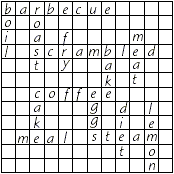
- Each student makes a crossword puzzle grid of 12 by 12 lines.
- Students use words from the unit and try to fit as many as possible on their grids. (Note: The following example grid uses words connected to food and cooking from Unit 4.)
- After ten minutes, stop the activity and find out who has the most words on the grid. Ask that student to read each word aloud and to spell each one; the rest of the class listens and circles any of the same words they may have on their grids.
|
Back to Top
|
|
|