|
|
|

|
Self-Improvement
The activities below provide fun exercises for the entire class when you have extra time. They are designed to be taught with specific exercises in this unit. Click on an activity in the list below or scroll down the page.
|
|

Go to the Resources Page for This Unit |
Information center
This activity is designed to be taught with Exercise 6, "Different Places, Different Ways!"
Time: 10–15 minutes. This activity practices describing services and facilities available in a city.
- Explain that students are members of a planning committee for a conference that is going to be held in your school or institution. During the conference, visitors will need information about services and facilities available in or near the conference center. The students' task is to produce a guide containing a list of useful information.
- Write the following list on the board:
Communications
telephone
fax
e-mail
Sightseeing
tours
museums
landmarks
shopping centers/malls
Entertainment
theater
shows
cultural events
|
|
Recreation
sports facilities
jogging
Transportation
buses
taxis
trains
Health
doctors
dentists
hospitals
|
- Students now work in groups to make their list of responses to possible questions that people at the conference might ask. The lists should be about a page long and consist of complete sentences using "You can/could . . . ." Set a time limit of about ten minutes.
- Elicit groups' ideas around the class.
|
Back to Top
|
Game – What's the problem?
This activity is designed to be taught with Exercise 9, "Grammar Focus: Suggestions."
Time: 10–15 minutes. This activity practices making suggestions and identifying problems.
Preparation: Each student will need three blank cards.
- Divide the class into two teams – A and B. Give each student three blank cards.
- Students think of three sentences that could be suggestions for solving problems (e.g., Have you thought about going to bed earlier? Why don't you stop drinking coffee? It might be a good idea to leave the house earlier.). Then students write one sentence on each card. Walk around and give help.
- Collect all the cards and put them in a pile facedown. Team A starts: One student picks up a card and reads it aloud to a student from Team B. That student tries to think of the problem that the suggestion is trying to solve. Students on both teams decide whether the problem and the suggestion match. If they do, Team B wins a point; if they don't, a student from Team A tries to come up with something more appropriate. If the correction is acceptable, Team A gets the point. The team with the most points wins.
|
Back to Top
|
Charades – abroad!
This activity is designed to be taught with Exercise 12, "Writing: Advice column."
Time: 10–15 minutes. This activity practices describing actions and giving suggestions or advice on how to solve a problem.
- Ask students to imagine that they are visiting a foreign country. They don't speak the language, and no one seems to understand English or their own language. However, there are some urgent things that students need to do or get done (e.g., make a photocopy; change a traveler's check; get some medicine).
- Students form groups and think of five actions to mime. Each action should be something that can be mimed in front of the class (e.g., having a tooth checked; getting a shoe fixed). Set a time limit of about five minutes for this.
- Now groups take turns performing their mimes; other students try to first guess the activity and then give a suggestion or some advice, like this: "You have a toothache. You can get it checked by the dentist next to the train station."
|
Back to Top
|
Crossword puzzle
This activity is designed to be taught with Exercise 13, "Reading: How to improve your memory." See also the new crossword puzzle created for Review of Units 9-12 in the Puzzle Corner.
Time: 15 minutes. This activity is good for reviewing vocabulary in any unit and for practicing spelling.
- Each student makes a crossword puzzle grid of 12 by 12 lines.
- Students use words from the unit and try to fit as many as possible in their grids. (Note: The following example grid uses words connected with occupations and services from Unit 9.)
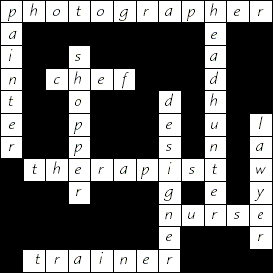
- After ten minutes, stop the activity and find out who has the most words in the grid. Ask that student to read each word aloud and to spell each one; the rest of the class listens and circles any of the same words they may have in their grids.
|
Back to Top
|
|
|
