|
|
|

|
Challenges and Accomplishments
The activities below provide fun exercises for the entire class when you have extra time. They are designed to be taught with specific exercises in this unit. Click on an activity in the list below or scroll down the page.
|
|

Go to the Resources Page for This Unit |
Crossword puzzle
This activity is designed to be taught with Exercise 4, "Word Power: Antonyms." See also the new crossword puzzle created for Review of Units 13-16 in the Puzzle Corner.
Time: 15 minutes. This activity is good for reviewing vocabulary in any unit and for practicing spelling.
- Each student makes a crossword puzzle grid of 12 by 12 lines.
- Students use words from the unit and try to fit as many as possible in their grids. (Note: The following example grid uses words connected with occupations and services from Unit 9.)
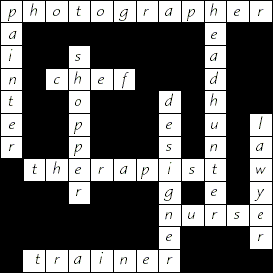
- After ten minutes, stop the activity and find out who has the most words in the grid. Ask that student to read each word aloud and to spell each one; the rest of the class listens and circles any of the same words they may have in their grids.
|
Back to Top
|
Interesting statements
This activity is designed to be taught with Exercise 6, "Special Challenges."
Time: 10–15 minutes. This activity practices expressing opinions.
- Write these phrases on the board:
- The most challenging thing about . . . .
- One of the rewards of . . . .
- The best thing about . . . .
- The most interesting aspect of . . . .
- Ask students to work in pairs or groups. Tell them that their task is to complete each one, using a complex noun phrase with a gerund. Encourage students to make statements about everyday life rather than about serious issues.
- Set a time limit of about ten minutes. Walk around and give help as needed. Afterward, have students share their more interesting statements with the rest of the class.
|
Back to Top
|
Hooray! It's the end of the course!
This activity is designed to be taught with Exercise 11, "Writing."
Time: 15–20 minutes. This activity gives students the chance to decide if and how they might want to celebrate the end of the course in some special way (e.g., having a party in class; going out somewhere together; planning a student show and potluck dinner).
- First, take a class vote (through a show of hands or by secret ballot) on whether students are interested in doing something special to celebrate the end of the course. If the majority decides they want to, give them time to make plans, like this:
- Brainstorm with the class on some ways or ideas on how to celebrate; write them on the board.
- Again, take a class vote – this time, asking students to decide which idea they like the best.
- Then let a volunteer take over the brainstorming on what kinds of plans the class needs to make and who will be in charge of each part (e.g., choosing the date/place/time; organizing transportation or entertainment; food/drinks; cost per student, if appropriate).
- If students want to break up into groups to plan certain parts of the celebration, give them about ten minutes for this. (Note: In any remaining classes, give students some time to review their plans and to make any last-minute announcements.)
|
Back to Top
|
Words, words, words!
This activity is designed to be taught with Exercise 12, "Reading: Adam Ezra Cohen."
Time: 15–20 minutes. This is a vocabulary-building activity that can be used in any unit.
Preparation: Select five lengthy words (e.g., Unit 7: educational, contaminated, pollution, overcrowding, corruption).
- Divide the class into pairs. Explain that students will try to make as many new words as they can from the letters of a given word.
- Now write the word educational on the board and ask students to make as many new words from it as they can in three minutes.
- Find out which pair made the most new words and ask them to read their list aloud. Then continue in the same way until all five of your words have been used, or until time is up. Who made the most words?
|
Back to Top
|
|
|
